
The text comes at 7:43 AM, which is early even for Dad.
No words. Just a photo. This is how David Champion communicates—biscuits, coffee beans, images without context, and the expectation that you'll understand what he means because explaining would require more words than he's allocated for the week.
I'm behind the counter, steam wand in hand, making my first espresso of the day, when my phone buzzes. I glance at it expecting biscuits, because Dad's photo texts are almost always biscuits, and instead I see—
I drop the portafilter.
It clatters against the counter, grounds scattering everywhere, and I don't care because I'm staring at my phone screen at a coffee mug I haven't seen in twenty years.
Lumpy. Glazed wrong, the blue bleeding into the white in places it shouldn't. And there, in wobbly eight-year-old handwriting, the words I'd been so proud of:
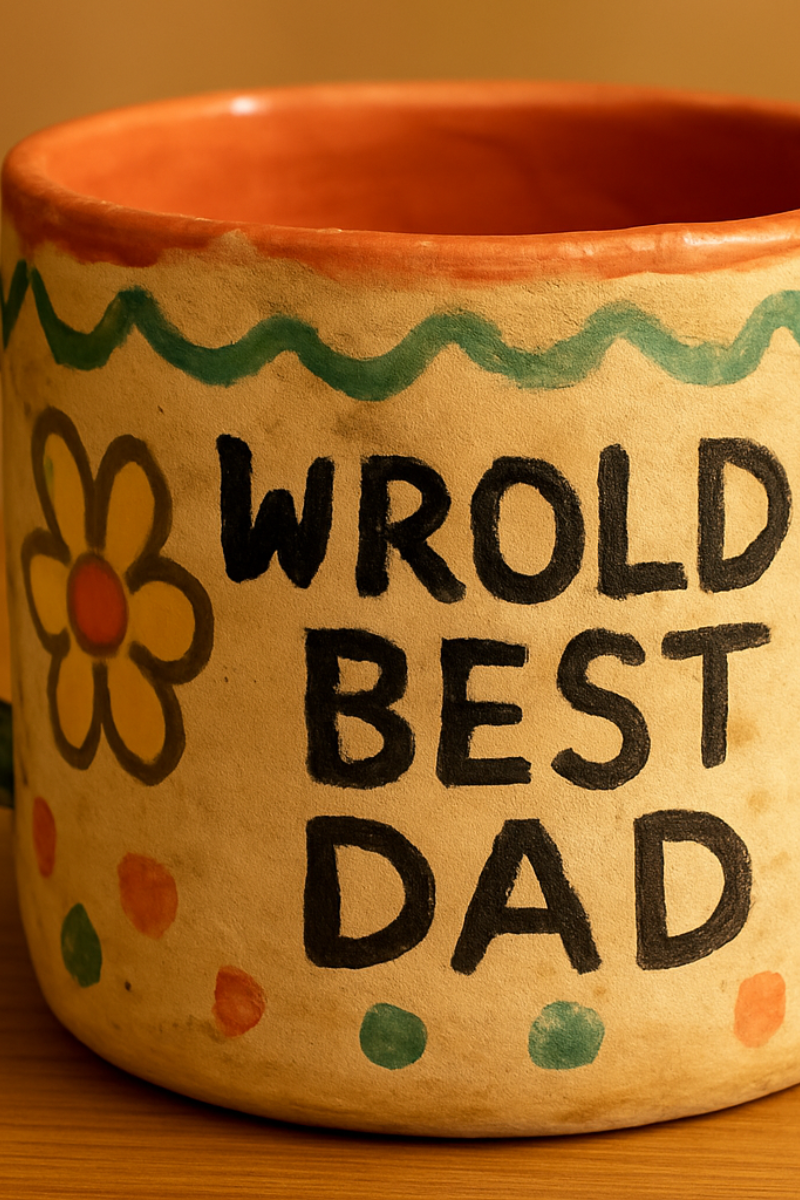
WROLDS BEST DAD
I misspelled "world's." I was eight. I didn't know.
I made it in the church craft room, that basement space that smelled like tempera paint and ancient hymnals. Mrs. Patterson had set up a glazing station, and I hadn't listened to the part about letting layers dry. I was too excited. Dad drank coffee every morning from the same chipped mug he'd had forever, and I was going to make him something better.
Something from me.
I gave it to him on Father's Day, wrapped in tissue paper I'd colored myself. He turned it in his hands, ran his thumb over the lumpy handle.
"Best mug I ever got," he said.
I believed him.
Three weeks later, Mother found it during one of her cabinet purges.
"David. We can't serve company with this."
I was in the doorway. I don't think she knew I was there.
"It's Rena's," Dad said quietly.
"It's misspelled. And look at this glaze—it's a mess. This isn't fit for company."
She put it in the box with the other things that weren't good enough—the chipped plate, the faded towels. The box that went to Goodwill, or the trash, or wherever things went when they failed to meet the standard.
Dad didn't say anything else.
The mug was gone the next day. I never saw it again.
Until now.
I call him.
This is unprecedented. We text. We have our Tuesdays now. But phone calls are for emergencies.
He answers on the second ring.
"Rena."
"Dad." My voice is doing something strange. "The mug."
A pause. David Champion pauses are their own language.
"Found it cleaning the workshop," he says finally. "Behind the paint cans. Been there awhile."
"You kept it."
Another pause. Longer.
"Course I did."
I'm sitting on the floor of my shop, back against the counter, coffee grounds still scattered everywhere, and I'm crying the way I learned not to cry when I was eight—silent, just tears, no sound.
"I thought—" I start, and have to stop. "Mother said it wasn't fit for company."
"It wasn't." His voice is matter-of-fact. "Wasn't for company. Was for me."
"Workshop's got good coffee?" he asks, and I realize this is an invitation.
"I can bring some."
"Tuesday works. But today's fine too."
I park in the driveway and go around back to Dad's workshop. He's sitting on a stool, the mug on the workbench in front of him.
"Brought coffee," I say, holding up the thermos. Medium roast Colombian. Nothing fancy. Dad coffee.
He nods toward the workbench. "Only got one mug."
I pour coffee into the mug and hand it to him. My hands shake and I spill some on the workbench, and he wipes it up with a rag without comment, the same way he's been quietly cleaning up my messes my whole life.
He takes a sip. Hands the mug to me.
We pass it back and forth in silence, drinking from the mug I made when I was eight, the one I thought was thrown away, the one that wasn't fit for company but was fit for him.
"She didn't mean it cruel," Dad says eventually. "Your mother. She wanted things right. Couldn't always tell the difference between right and perfect."
"She put it in the box."
"She did." A pause. "I took it out."
I think about all the things Mother put in boxes over the years. The jeans. The books. The version of me that didn't fit. And I think about Dad, quietly taking things out of boxes when she wasn't looking.
"You never said anything."
"Didn't know how. Still don't, mostly. But I'm trying."
I think about his texts—biscuits with no context, "Tuesday works," the photo of a mug at 7:43 AM. All the things he's said without saying them.
"I know, Dad."
We sit in the workshop, passing the mug back and forth, and I understand something I couldn't understand when I was eight:
He kept it.
All those years, all that silence—he kept it.
When I leave, he walks me to the car.
"Can I take it?" I gesture at the mug. "For the shop?"
He looks at it. Looks at me.
"It's yours," he says. "Always was."
I drive home with a twenty-year-old mug in my passenger seat and something in my chest that feels like a door opening—not all at once, but just a crack.
Just enough to let light in.
The mug goes on the shelf behind Betsy, next to Noah's scoop and the laminated sleeve and Lily's daisy mug.
The shelf of things that matter.
WROLDS BEST DAD.
Misspelled. Lumpy. Not fit for company.
Kept anyway.
[^1]: Twenty years. He kept it for twenty years. I don't know what to do with that except hold it, the way I'm learning to hold everything that's too big for words.
Comments
Loading comments...